
Are you concerned about solar cleaning rainwater tank safety? You are right to be worried. The convergence of decentralized energy generation and sustainable water harvesting on Australian residential rooftops represents a significant milestone in the nation’s environmental resilience. However, this dual utility—where the roof acts simultaneously as a power station and a drinking water catchment—introduces a complex matrix of chemical risks that are frequently underestimated by homeowners, contractors, and regulatory bodies. As of 2025, the proliferation of specialized solar panel cleaning agents, often marketed with ambiguous “eco-friendly” or “biodegradable” claims, necessitates a rigorous re-evaluation of water safety protocols.
This high-authority guide provides an exhaustive forensic analysis of the interactions between solar maintenance chemicals and potable rainwater systems. By synthesizing data from Safety Data Sheets (SDS), enHealth guidelines, Australian Standards, and hydraulic engineering principles, this report establishes a critical safety baseline: the introduction of any surfactant, solvent, or biocide-based cleaning agent into a connected potable rainwater system constitutes a breach of water safety standards. The risks range from acute gastrointestinal toxicity and chronic organ exposure to the disruption of the delicate biological equilibrium within the tank that maintains water quality.
The analysis reveals that traditional engineering controls, such as first flush diverters, are hydraulically insufficient to manage the volume of wastewater generated during cleaning operations. Furthermore, the “biodegradability” of cleaning agents, defined under AS 4351 by a 28-day degradation timeline, offers no protection against acute ingestion risks immediately following a cleaning event. Consequently, this report advocates for a strict “disconnection protocol” or the exclusive use of deionized water as the only scientifically defensible methods for maintaining solar efficiency without compromising public health.
The Australian Rooftop: A Conflict of Utilities
The modern Australian roof is an active industrial zone. With over 3.7 million photovoltaic (PV) installations across the continent, Australia leads the world in per capita solar uptake. Simultaneously, rainwater harvesting remains a cornerstone of water security, particularly in rural and peri-urban regions where reticulated mains water is unavailable or where residents seek autonomy from utility providers.1 This co-location of energy and water infrastructure creates a unique environmental health hazard: the maintenance requirements of the former directly threaten the purity of the latter.
The Imperative for Cleaning vs. Water Safety
Solar photovoltaic panels rely on optical transparency to function. The accumulation of “soiling”—a matrix of dust, pollen, bird droppings, salt mist, and industrial particulate—can degrade system performance significantly. Research indicates that while rainfall can provide superficial cleaning for tilted panels, it is often insufficient to remove cemented grime, lichen, or heavy bird fouling, particularly on flat or low-pitch installations.3 This performance gap drives the solar cleaning industry, which employs a variety of chemical and mechanical methods to restore optical efficiency.
However, the catchment surface for the rainwater tank is the exact surface being treated. Unlike a car wash where wastewater enters a trade waste sewer, solar cleaning runoff flows directly into the guttering system and, without intervention, into the rainwater tank. The enHealth “Guidance on use of Rainwater Tanks” explicitly states that rainwater must be free from harmful levels of chemicals to ensure a safe drinking supply.5 The document warns that while disinfection can manage microorganisms, it does not remove chemicals. Therefore, the introduction of industrial cleaning agents onto the catchment surface fundamentally contradicts the primary barrier approach to water safety, which relies on exclusion rather than treatment.
Defining the Risk Profile: Potable vs. Non-Potable
The risk posed by solar cleaning chemicals is stratified by the end-use of the harvested water.
- Potable Systems (High Risk): In scenarios where rainwater is used for drinking, cooking, bathing, and oral hygiene, the tolerance for chemical contamination is effectively zero. The Australian Drinking Water Guidelines (ADWG) set stringent aesthetic and health values for dissolved organics and turbidity.6 The ingestion of surfactants or solvents, even in trace amounts, can render water unpalatable or biologically hazardous.
- Non-Potable Systems (Moderate Risk): Where water is used solely for toilet flushing or garden irrigation, the acute health risk to humans is reduced. However, environmental risks persist. Surfactants can damage soil structure, harm aquatic life if overflow reaches stormwater drains, and disrupt the operation of septic systems by killing beneficial bacteria.7
This report focuses primarily on the potable risk scenario, as it represents the most critical threat to human health and safety.
Chemical Forensic Analysis: Deconstructing “Solar Soap”
To assess the toxicity risk, one must look beyond the marketing claims on the bottle and examine the chemical composition of solar cleaning agents. Manufacturers often use terms like “organic,” “neutral pH,” and “biodegradable” to imply safety. However, a toxicological review of common ingredients reveals a different reality when these substances are introduced into a closed drinking water system.
The Surfactant Load
Surfactants (surface-active agents) are the primary active ingredients in solar cleaners. They function by lowering the surface tension of water, allowing it to wet the glass surface more effectively and lift hydrophobic contaminants like soot or pollen.7
Anionic Surfactants
Anionic surfactants, such as Sodium Dodecyl Sulfate (SDS) or Linear Alkylbenzene Sulfonates (LAS), are commonly used for their high cleaning power.
- Toxicity Mechanism: These compounds work by disrupting lipid membranes. In the context of a rainwater tank, they are highly toxic to the aquatic microorganisms that form the “biofilm” on the tank walls. This biofilm plays a crucial role in maintaining water quality by outcompeting pathogenic bacteria. Destroying it with anionic surfactants can lead to a crash in the tank’s ecosystem.8
- Human Health: While low concentrations may not be lethal, anionic surfactants act as irritants to the gastrointestinal tract. Ingestion can cause nausea, vomiting, and diarrhea. Furthermore, they impart a distinct, soapy taste to water at concentrations as low as 0.5 mg/L, rendering the entire tank volume unpalatable.7
Non-Ionic Surfactants
Non-ionic surfactants, including Alkyl Polyglucosides (APGs) and Alcohol Ethoxylates, are frequently marketed as “eco-friendly” alternatives derived from plant sugars or oils.10
- The “Natural” Fallacy: While APGs are less irritating to skin than anionics, they are not benign. They are still powerful detergents. When introduced into a rainwater tank, they increase the dissolved organic carbon (DOC) load significantly. High DOC levels provide a food source for bacterial regrowth, potentially leading to blooms of opportunistic pathogens like Aeromonas or Pseudomonas in the stored water.11
- Foaming: Non-ionic surfactants can produce persistent foam. Foam in a water tank inhibits gas exchange at the surface, potentially leading to anaerobic conditions, sulphide production (rotten egg smell), and the mobilization of heavy metals from the sludge layer.13
Solvents and Coupling Agents
To remove oily residues from diesel exhaust or tree sap, manufacturers often include solvents. These are particularly insidious because they are miscible in water, meaning they dissolve completely and do not settle out in the sludge, making them impossible to remove via sedimentation.
2-Butoxyethanol (Glycol Ethers)
This solvent is ubiquitous in glass and hard surface cleaners due to its ability to dissolve both grease and water-soluble soils.14
- Health Hazards: 2-Butoxyethanol is readily absorbed through the skin and lungs, as well as the gastrointestinal tract. Acute exposure causes irritation, but chronic exposure—which could occur if a tank is contaminated and the water is consumed over weeks—is linked to hematotoxicity (destruction of red blood cells) and damage to the liver and kidneys.14
- Regulatory Status: While the ADWG does not have a specific line item for 2-butoxyethanol, its presence violates the general guideline that drinking water should be free of dissolved solvents and offensive tastes. The S.A. Health and enHealth guidelines strictly advise against collecting water from areas affected by industrial emissions; applying industrial solvents directly to the roof is functionally equivalent.1
Isopropyl Alcohol (Isopropanol)
Used for its rapid evaporation properties to prevent streaking.18
- Tank Impact: While volatile, isopropanol introduced in bulk during a cleaning session adds to the chemical oxygen demand (COD) of the water. As bacteria break it down, they consume oxygen, potentially driving the tank into anoxic conditions which can solubilize iron and manganese, leading to dirty, metallic-tasting water.5
Biocides and Preservatives
Solar cleaning solutions, especially those sold as concentrates, require preservatives to prevent bacterial growth in the bottle.
- Isothiazolinones (MIT/CMIT): Methylisothiazolinone is a potent sensitizer and contact allergen.18 In the environment, it is highly toxic to aquatic organisms. In a rainwater tank, it acts as a broad-spectrum biocide.
- Mechanism of Harm: By killing the natural, beneficial bacterial flora in the tank, biocides remove the competitive pressure that keeps pathogens in check. This can allow more resistant, harmful organisms to proliferate. Furthermore, the ingestion of biocides, even at dilute levels, is medically inadvisable and contravenes the principle of safe water supply.5
Chelating Agents and Heavy Metal Mobilization
Chelating agents like EDTA (Ethylenediaminetetraacetic acid) or sodium gluconate are added to prevent hard water spots by binding calcium and magnesium ions.10
- The Lead Connection: Roofs often contain lead in the form of flashing, washers, or older soldering.5 In a normal state, lead oxidizes and becomes relatively stable. However, chelating agents are non-selective; they will bind to lead and copper ions just as readily as calcium. This “mobilization” process pulls heavy metals out of the roof infrastructure and keeps them in a dissolved state in the water column, preventing them from settling into the sludge where they would be safer. This can lead to elevated lead levels at the tap, posing severe neurotoxic risks, particularly to children.5
Summary of Chemical Risks
The following table synthesizes the data from various Safety Data Sheets and toxicological profiles to present the specific risks of common solar cleaning ingredients.
| Chemical Class | Common Ingredients | Function | Environmental/Health Risk in Rainwater Tank |
| Surfactants | Alkyl Polyglucosides 10, Sodium Dodecyl Sulfate 24, Alcohol Ethoxylates 7 | Lifting dirt, wetting | Biofilm destruction: Kills beneficial tank bacteria. Aesthetics: Causes foaming and soapy taste. Microbial Regrowth: Increases nutrient load (DOC). |
| Solvents | 2-Butoxyethanol 14, Isopropyl Alcohol 18 | Degreasing, streak-free drying | Systemic Toxicity: Potential liver/kidney damage (chronic). Hematotoxicity: Red blood cell damage. Solubility: Dissolves fully; cannot be filtered out. |
| Biocides | Benzalkonium Chloride 7, Isothiazolinones (MIT/CMIT) 20 | Algae removal, product preservation | Acute Toxicity: High aquatic toxicity. Sensitization: Skin allergens. Ecological Collapse: Sterilizes tank, leading to anaerobic spoilage. |
| Chelating Agents | EDTA, Sodium Gluconate 21 | Water softening, scale prevention | Heavy Metal Mobilization: Strips lead/copper from roof flashings and keeps them dissolved in drinking water. |
| Acids/Alkalis | Citric Acid, Sodium Hydroxide | pH adjustment | Corrosion: Accelerates leaching of metals from plumbing and roof sheets. pH Shock: Disrupts tank water balance. |
The “Biodegradable” Trap: Regulatory Definitions vs. Reality
A critical failure point in consumer safety is the misunderstanding of the term “biodegradable.” In the context of solar cleaning products, this term is often used to reassure users that the runoff is safe. However, the regulatory definition of biodegradability is wholly inadequate for ensuring the safety of potable water.
Australian Standard AS 4351
The relevant standard for biodegradability in Australia is AS 4351 Biodegradability – Organic Compounds in an Aqueous Medium.9
- The 28-Day Window: To be classified as “readily biodegradable” under this standard (and aligned OECD guidelines), a substance must demonstrate a degradation of 60-70% within a 28-day period.7
- The Potable Water Disconnect: Rainwater tanks are dynamic systems used daily. If a solar cleaning event occurs on a Saturday, and the water is consumed on Sunday, the chemical agents have had only 24 hours to degrade. The fact that they will be harmless in a month is irrelevant to the family drinking the water the next day. The “biodegradable” label refers to environmental persistence, not immediate toxicity.
Aerobic vs. Anaerobic Degradation
Biodegradability tests are typically conducted in aerobic (oxygen-rich) environments, simulating river water or sewage treatment plants.27
- The Tank Environment: The bottom of a rainwater tank, where the sediment layer (sludge) accumulates, is often anoxic or anaerobic (oxygen-poor).11 Many surfactants and solvents that degrade quickly in air-rich water persist for much longer in anaerobic conditions. If these chemicals bind to sediment particles and settle to the bottom, they can remain potent for months, resuspending into the water column during heavy rain events or when the tank level is low.
Greenwashing and Certification Limits
Organizations like GECA (Good Environmental Choice Australia) provide certifications for cleaning products based on lifecycle assessment, including toxicity to aquatic life and packaging sustainability.27
- Scope Limitation: A GECA certification confirms that a product is a better environmental choice than standard petrochemicals. It does not certify that the product is “food grade” or safe for addition to drinking water. There is currently no certification in Australia that validates a detergent for ingestion.
- ACCC Regulations: The ACCC rigorously prosecutes “greenwashing”—misleading environmental claims.31 Claims like “Tank Safe” are legally perilous unless backed by specific testing against drinking water standards (AS 4020). To date, few if any solar cleaning chemicals carry legitimate, verified “Safe for Potable Water” certifications.
Hydraulic Failure: Why “First Flush” Diverters Don’t Work for Chemicals
A common but dangerous misconception is that a First Flush Diverter (FFD) will protect the tank from cleaning chemicals. While FFDs are effective at managing dust and bird droppings, they are hydraulically unsuited for managing the wastewater from a cleaning operation.
The Mechanism of First Flush
First flush diverters work by intercepting the initial volume of runoff from a rain event, which carries the highest concentration of particulates (the “first flush” phenomenon). Once the diverter chamber is full, a ball valve seals the chamber, and the subsequent “cleaner” water flows to the tank.33
Volume Mismatch Analysis
- Diverter Capacity: A typical residential FFD uses 90mm or 100mm PVC pipe. A 1.5-meter long diverter holds approximately 8 to 12 liters of water.34
- Cleaning Volume: Cleaning a standard 6.6kW solar array (approx. 20 panels) using a hose-fed brush or spray system typically consumes 100 to 200 liters of water (assuming 5-10 liters per panel for wetting, washing, and rinsing).
- The Bypass: The FFD captures the first 10 liters of runoff. The remaining 90-190 liters—containing the bulk of the detergent, dissolved dirt, and mobilized heavy metals—bypass the full diverter and flow directly into the rainwater tank. The diverter fails to sequester 90% of the contaminant load.
Dissolution Physics
First flush theory relies on the principle that contaminants are suspended particles that wash off early.
- The Chemical Reality: Cleaning chemicals are dissolved solutes. They are mixed homogeneously throughout the entire volume of the cleaning water. Unlike dust, which washes off in the first few minutes of rain, the detergent concentration remains relatively constant throughout the cleaning process. Therefore, diverting the first fraction of the flow does practically nothing to reduce the chemical concentration of the water entering the tank.12
The “Drip” Factor
FFDs have a “weep hole” or dripper designed to slowly empty the chamber between rain events.
- Risk: If the cleaning process is slow (e.g., using a low-flow backpack sprayer), the rate of inflow might match the rate of outflow through the dripper. The diverter never “seals,” but it also doesn’t capture the bypass. Worse, if the weep hole drains onto the ground near the tank, it concentrates chemicals in the soil foundation. If the weep hole is clogged (common with sludge), the diverter is effectively non-functional, and 100% of the chemical runoff enters the tank immediately.33
The Biological Ecosystem: Biofilms and Biostability
A rainwater tank is not a sterile vessel; it is a living ecosystem. The safety of the water relies heavily on this biological stability, which cleaning chemicals threaten to disrupt.
The Role of Biofilms
Research indicates that the walls and floor of a mature rainwater tank are coated in a beneficial biofilm. This microbial layer adsorbs heavy metals and outcompetes pathogenic bacteria for nutrients, effectively “polishing” the water.8
- Chemical Disruption: Biocides (like quaternary ammonium compounds) and surfactants in cleaning agents are indiscriminate killers. They can strip this biofilm or kill the beneficial bacteria.
- Consequences:
- Pathogen Resurgence: With the beneficial competition removed, dangerous pathogens like Salmonella or E. coli (from bird droppings) can proliferate rapidly if they are introduced subsequently.
- Nutrient Spike: The death of the biofilm releases a massive pulse of nutrients (dead bacterial cells) into the water, fueling algal blooms and creating taste and odor issues.11
Anaerobic Zones and Sludge
The sediment layer at the bottom of the tank accumulates over years. It contains heavy metals (lead, cadmium) and organic matter.
- Resuspension: The physical act of cleaning usually involves a sudden influx of water, often at a higher velocity than typical light rainfall. This turbulence can stir up the sludge layer, resuspending historical contaminants into the drinking water.
- Chemical Interaction: Surfactants can interact with the sludge, solubilizing organics and metals that were previously bound to the sediment particles, making them bioavailable again.29
Safe Work Method Statements (SWMS): The Disconnection Protocol
Given the chemical and hydraulic risks detailed above, the only robust safety measure is the physical isolation of the rainwater system during cleaning. The following Safe Work Method Statement (SWMS) outlines the mandatory procedure for 2025.
The Disconnection Protocol (Mandatory for Chemical Use)
This protocol must be followed whenever any cleaning agent—including those labeled “natural” or “biodegradable”—is applied to a roof with a potable water catchment.
Step 1: System Identification and Isolation
- Identify: Trace all downpipes from the solar array to the tank. Note that some systems may have “wet” (underground) systems that are harder to isolate.
- Disconnect:
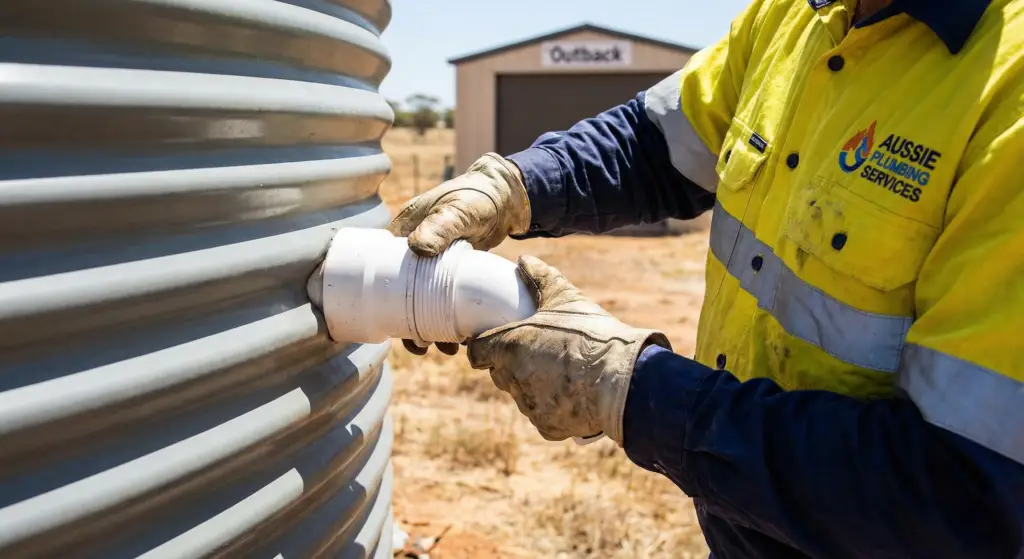
- Above Ground: Physically remove the downpipe section feeding the tank strainer. Install a temporary diverter or flexible hose to direct flow to a garden bed, stormwater drain, or dispersal area.38
- Wet Systems: Close the inlet valve to the tank. Open the inspection/flush point at the lowest part of the wet system to allow runoff to drain to waste.
- First Flush Diverters: Do not rely on them. Unscrew the bottom cap entirely to allow all water to flow through the chamber and out, preventing it from backing up into the tank line.34
Step 2: The Cleaning Process
- Application: Apply the cleaning solution and agitate with a soft brush.
- Rinsing: Rinse panels thoroughly.
- Gutters: Critical Step. The chemical residue will settle in the gutters. You must flush the gutters with clean water until the runoff exiting the disconnected downpipe is clear and free of suds.
Step 3: The “Next Rain” Rule
- Wait: Ideally, leave the system disconnected until the next significant rainfall event (approx. 5-10mm). This natural “rinse cycle” ensures that any dried residue on the roof or in the gutters is washed away to waste.
- Reconnect: Only after this flush should the downpipes be reconnected to the tank.
The “Water-Only” Alternative (Low Risk)
If disconnection is logistically impossible (e.g., complex plumbing, inaccessible pipes), then chemicals must not be used.
Deionized (DI) Water Systems
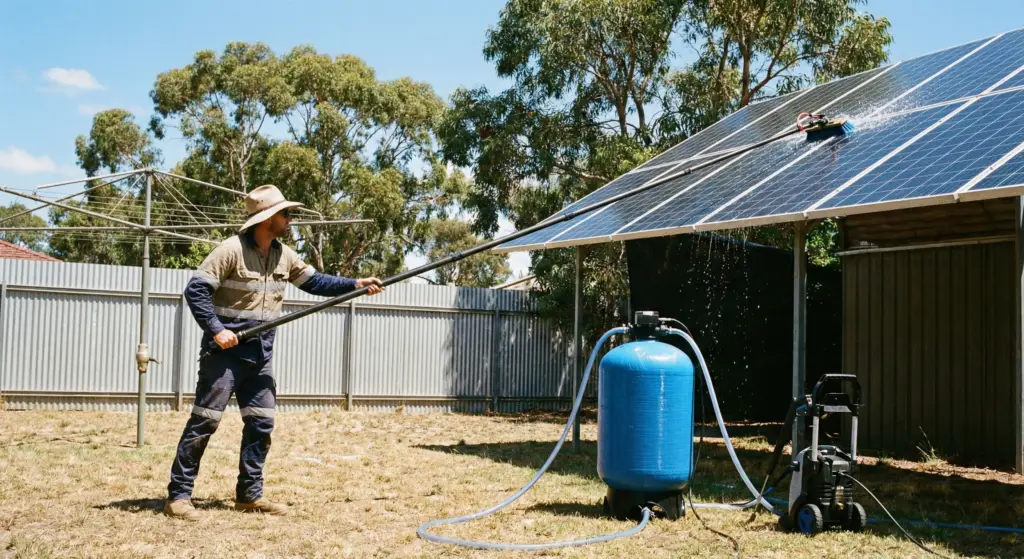
- Mechanism: DI water has had all mineral ions removed. It is “hungry” water that aggressively binds to dirt and leaves no mineral spots upon drying.3
- Safety: The runoff consists only of water and the natural dust/bird droppings already present on the roof. This load is within the design capacity of the tank’s filtration and sedimentation systems.
- Efficiency: DI water systems with water-fed poles allow cleaning from the ground or gutter line, improving operator safety.
Mechanical Agitation
- Use high-quality, non-abrasive brushes to physically loosen dirt. Rely on friction and water flow rather than chemical solvency.
Prohibited Practices
- Pressure Washing: High-pressure water can drive contaminants through the seals of the solar panels, causing electrical faults, and can force chemical mist into the roof cavity. It can also damage the anti-reflective coating on the glass.41
- Abrasive Scrubbing: Never use scouring pads. Scratched glass reduces solar output and increases the rate of future soiling.42
Regulatory Framework and Compliance
Failure to adhere to safe practices can result in legal liability and non-compliance with Australian standards.
enHealth and ADWG Compliance
The enHealth guidelines are the benchmark for duty of care. By introducing chemicals into a tank, a contractor or homeowner is arguably creating a “nuisance” under public health acts if that water becomes unfit for use. The ADWG aesthetic guidelines (taste/odor) are the first to be breached by surfactants.
AS/NZS 3500 and AS 4020
- AS 3500 (Plumbing): Requires that materials and products used in plumbing systems do not contaminate the water. While intended for pipes and fittings, the principle extends to maintenance inputs.
- AS 4020 (Materials in Contact with Drinking Water): This standard tests for the leaching of toxic substances. Solar cleaning chemicals are not certified to AS 4020. Introducing a non-certified chemical fluid into a potable water asset is a violation of best practice and potentially voids insurance policies regarding water damage or health claims.43
ACCC and Consumer Law
The ACCC has taken a strong stance against “Greenwashing.” Companies claiming their products are “Tank Safe” without rigorous, specific evidence (such as AS 4020 compliance testing) face significant penalties. Homeowners should be skeptical of any product label that claims safety for drinking water without displaying a valid third-party certification specifically for ingestion safety, not just environmental degradability.31
Remediation: What to Do If Contamination Occurs
If cleaning chemicals have entered a potable rainwater tank, immediate action is required to mitigate health risks.
Step 1: Isolate and Assess
- Immediately disconnect the tank from the house supply (turn off the pump or close the outlet valve).
- Check for signs of contamination: foaming when water is agitated, chemical odor, or a “slick” on the water surface.45
Step 2: Drain and Clean
- Do Not Dilute: Attempting to dilute the chemical by adding more water is unsafe. Surfactants can remain biologically active and taste-perceptible at extremely low concentrations.
- Empty the Tank: Drain the tank completely. Ensure disposal of the chemically contaminated water complies with local council environmental regulations (e.g., do not drain into a natural watercourse).29
- Sludge Removal: This is an opportune time to de-sludge the tank, as the sediment may have adsorbed chemical residues.
Step 3: Refill and Retest
- Refill with clean water (rain or carted).
- Flush the household pipes to ensure no chemical residue remains in the lines.
Conclusion
The 2025 Safety Guide concludes that the only way to guarantee the safety of a potable rainwater tank during solar panel cleaning is to ensure that no chemical agents enter the system.
The physics of hydraulic bypass renders first flush diverters ineffective for this purpose. The chemistry of “biodegradable” detergents fails to protect against acute toxicity in the short term. The biology of the tank ecosystem is too fragile to withstand the antimicrobial shock of preservatives and surfactants.
Key Takeaways:
- Chemicals = Disconnection: If you use any chemical, you must physically disconnect the downpipes.
- Water is King: Deionized water with mechanical brushing is the superior, safe method for solar maintenance on tank-connected roofs.
- Greenwashing Alert: “Eco-friendly” does not mean “drinkable.”
- Preserve the Biofilm: Protecting the natural ecology of your tank is as important as keeping the chemicals out.
By adhering to the Disconnection Protocol or the Water-Only Method, Australians can maintain the high efficiency of their solar assets without compromising the essential safety of their water supply.
Table: Comparison of Cleaning Methods and Tank Safety
| Cleaning Method | Efficacy on Soiling | Risk to Potable Tank | Safety Protocol Required |
| Rainfall Only | Low (Does not remove cemented grime) | None | None |
| Mains Water Hose | Moderate (Removes dust, not lichen) | Negligible (Chlorine may affect biofilm slightly) | None |
| Deionized Water + Brush | High (Best practice) | None | None (Safe to enter tank) |
| “Eco” Detergent + Connected Downpipe | High | High (Chemical Ingestion Risk) | UNSAFE – DO NOT USE |
| “Eco” Detergent + First Flush Diverter | High | High (Bypass Likely) | UNSAFE – DO NOT USE |
| Chemical Cleaner + Disconnected Downpipe | High | None (If disconnection is total) | Mandatory Disconnection |
This report is based on current enHealth guidelines, Australian Standards (AS 4351, AS 3500, AS 4020), and toxicological data available as of 2025. Always consult the Safety Data Sheet (SDS) and a licensed professional before undertaking maintenance.
Is it safe to use biodegradable cleaner on solar panels with a rainwater tank?
No. u0022Biodegradableu0022 means the chemical breaks down over 28 days. If you drink the water the next day, it can still be toxic. Surfactants disrupt the healthy biofilm in your tank and can cause bacterial regrowth.
Will a ‘First Flush Diverter’ stop cleaning chemicals?
No. First flush diverters are designed for dust and debris, not dissolved liquids. Cleaning chemicals mix with the water and bypass the diverter, flowing directly into your drinking supply.
u003cstrongu003eWhat is the safest way to clean panels if I drink the water?u003c/strongu003e
The only 100% safe method is the u003cstrongu003eu0022Disconnection Protocolu0022u003c/strongu003e: physically disconnect your downpipes before cleaning. Alternatively, use only u003cstrongu003eDe-ionized (DI) wateru003c/strongu003e with no soaps or chemicals, as this does not contaminate the tank.
References
- Rainwater – SA Health, fecha de acceso: diciembre 8, 2025, https://www.sahealth.sa.gov.au/wps/wcm/connect/public+content/sa+health+internet/public+health/water+quality/rainwater/rainwater
- Water Quality and the First-Flush Effect in Roof-Based Rainwater Harvesting, Part I – MDPI, fecha de acceso: diciembre 8, 2025, https://www.mdpi.com/2073-4441/16/10/1402
- Why Rain Doesn’t Clean Your Solar Panels and the Importance of Professional Cleaning, fecha de acceso: diciembre 8, 2025, https://energyaid.net/why-rain-doesnt-clean-your-solar-panels-and-the-importance-of-professional-cleaning/
- Is Solar Panel Cleaning A Waste Of Time And Money? – SolarQuotes, fecha de acceso: diciembre 8, 2025, https://www.solarquotes.com.au/blog/solar-panel-cleaning/
- Rainwater Treatment Fact Sheet | NSW Health, fecha de acceso: diciembre 8, 2025, https://www.health.nsw.gov.au/environment/water/Documents/Rainwater-Treatment-Fact-Sheet.pdf
- Ammonia – Australian Drinking Water Guidelines – NHMRC, fecha de acceso: diciembre 8, 2025, https://guidelines.nhmrc.gov.au/australian-drinking-water-guidelines/part-5/treatment-chemicals/ammonia
- Detergents in freshwater and marine water – Water Quality Australia, fecha de acceso: diciembre 8, 2025, https://www.waterquality.gov.au/anz-guidelines/guideline-values/default/water-quality-toxicants/toxicants/detergents-2000
- How to Maintain and Clean Rainwater IBC Totes, fecha de acceso: diciembre 8, 2025, https://www.ibctanks.com/knowledge-base/topics/rainwater-harvesting/how-to-maintain-and-clean-rainwater-ibc-totes
- Green Definitions – Chemform, fecha de acceso: diciembre 8, 2025, https://www.chemform.com.au/green-definitions/
- SOLAR PANEL CLEANER 32x CONCENTRATE SDS – Bare Ground Solutions, fecha de acceso: diciembre 8, 2025, https://www.bareground.com/wp-content/uploads/2023/05/SolarPanelCleaner.pdf
- Rainwater tanks: Maintenance and water care – Kangaroo Island Council, fecha de acceso: diciembre 8, 2025, https://www.kangarooisland.sa.gov.au/__data/assets/pdf_file/0025/345625/Rainwater-Tank-Maintenance-and-water-care-fact-sheet.pdf
- Analysis of first flush to improve the water quality in rainwater tanks – PubMed, fecha de acceso: diciembre 8, 2025, https://pubmed.ncbi.nlm.nih.gov/20107269/
- Effective first flush volumes in experimental household-scale rainwater catchment systems | AQUA – Water Infrastructure, Ecosystems and Society | IWA Publishing, fecha de acceso: diciembre 8, 2025, https://iwaponline.com/aqua/article/72/5/814/94741/Effective-first-flush-volumes-in-experimental
- Safety data sheet of SOLAR PANEL WASH – VF0406 (QT) VR0407 (GL) (Version 2), fecha de acceso: diciembre 8, 2025, https://images.thdstatic.com/catalog/pdfImages/e5/e5246a13-97cf-4696-ab0b-4613dba67b01.pdf
- Safety Data Sheet (SDS) – Fastenal, fecha de acceso: diciembre 8, 2025, https://img1.fastenal.com/infp360pmm/medias/docus/1265/$v10/0601013_sds_eng.pdf
- WINDOW CLEANER Safety Data Sheet – Taren Cleaning Supplies, fecha de acceso: diciembre 8, 2025, https://www.taren.com.au/assets/brochures/111046.pdf
- Roof Harvested Rainwater – Queensland Health, fecha de acceso: diciembre 8, 2025, https://www.health.qld.gov.au/__data/assets/pdf_file/0025/444427/factsheet-rainwater.pdf
- SolarUp™ Solar Panel Cleaner – Chemtools, fecha de acceso: diciembre 8, 2025, https://www.chemtools.com.au/download/data-sheets/safety-data-sheets/CT-SPC-SDS-032025-AUNZ.pdf
- What is the best way to clean solar panels – Community – Enphase Support, fecha de acceso: diciembre 8, 2025, https://support.enphase.com/s/question/0D52G00004QDbx4SAD/what-is-the-best-way-to-clean-solar-panels
- WATTS UP SOLAR PANEL CLEANER – CRC Industries, fecha de acceso: diciembre 8, 2025, https://crcindustries.com.au/media/msdsen/msds_en-1753427.pdf
- Safety Data Sheet (SDS) Section 1 – Chemical Product and Company Information – Shore Corporation, fecha de acceso: diciembre 8, 2025, https://shorecorporation.com/wp-content/uploads/2025/04/R001-Solar-Panel-Cleaner_SDS.pdf
- How Does Solar Panel Disposal Impact Water? – Pollution → Sustainability Directory, fecha de acceso: diciembre 8, 2025, https://pollution.sustainability-directory.com/question/how-does-solar-panel-disposal-impact-water/
- A Review of Health Hazards Associated with Rainwater Harvested from Green, Conventional and Photovoltaic Rooftops, fecha de acceso: diciembre 8, 2025, https://www.ijesd.org/vol12/1353-IJESD-1564.pdf
- glass cleaner – SAFETY DATA SHEET, fecha de acceso: diciembre 8, 2025, https://www.medline.com/media/catalog/Docs/MSDS/SDS%20EVSCHEM200.pdf
- Window cleaner concentrate RM 503 – Safety Data Sheet – Kärcher, fecha de acceso: diciembre 8, 2025, https://s1.kaercher-media.com/media/file/261951/window-cleaner-concentrate-sds_rm_503_8_2403_us.pdf
- Australian Standard 4351: 1996: Biodegradability – Organic Compounds in an Aqueous Medium. AS 4351.4:1996: Determination by Analysis of Released Carbon Dioxide (ISO 9439:1990) – Blackwell’s, fecha de acceso: diciembre 8, 2025, https://blackwells.co.uk/bookshop/product/Australian-Standard-4351-1996-Biodegradability-Organic-Compounds-in-an-Aqueous-Medium-AS-4351-41996-Determination-by-Analysis-of-Released-Carbon-Dioxide-ISO-94391990/9780733700873
- GS-53 Specialty Cleaning Products for I&I Use – Green Seal, fecha de acceso: diciembre 8, 2025, https://greenseal.org/standards/gs-53-specialty-cleaning-products-for-industrial-and-institutional-use/
- GS-37 Cleaning Products for Industrial and Institutional Use – Green Seal, fecha de acceso: diciembre 8, 2025, https://greenseal.org/standards/gs-37-cleaning-products-for-industrial-and-institutional-use/
- Rain Tanks | How to Clean a Rainwater Harvesting Tank, fecha de acceso: diciembre 8, 2025, https://www.ntotank.com/blog/how-to-clean-a-rainwater-harvesting-tank
- Standards — GECA – Good Environmental Choice Australia, fecha de acceso: diciembre 8, 2025, https://www.geca.eco/standards
- Environmental and sustainability claims – ACCC, fecha de acceso: diciembre 8, 2025, https://www.accc.gov.au/consumers/advertising-and-promotions/environmental-and-sustainability-claims
- Greenwashing Defined: Legal Risks for Australian Businesses | Sprintlaw, fecha de acceso: diciembre 8, 2025, https://sprintlaw.com.au/articles/greenwashing-defined-legal-risks-for-australian-businesses/
- Rainwater harvesting first flush comparison – HarvestH2o, fecha de acceso: diciembre 8, 2025, https://www.harvesth2o.com/first_flush.shtml
- 4″ Round Downpipe First Flush Water Diverter Kit – National Tank Outlet, fecha de acceso: diciembre 8, 2025, https://www.ntotank.com/4inch-round-downpipe-first-flush-water-diverter-kit-x6995241
- Analysis of first flush to improve the water quality in rainwater tanks …, fecha de acceso: diciembre 8, 2025, https://www.researchgate.net/publication/41166277_Analysis_of_first_flush_to_improve_the_water_quality_in_rainwater_tanks
- How To Make a First Flush Diverter: DIY Roof Washer, fecha de acceso: diciembre 8, 2025, https://www.reuse-repurpose-save.com/post/how-to-make-a-first-flush-diverter-diy-roof-washer
- Water collection tanks and safe household water – HE10148 – HealthEd, fecha de acceso: diciembre 8, 2025, https://healthed.govt.nz/products/water-collection-tanks-and-safe-household-water
- A Guide to Cleaning Gutters and Downpipes – H2O Warehouse, fecha de acceso: diciembre 8, 2025, https://h2owarehouse.co.za/pages/a-guide-to-cleaning-gutters-and-downpipes
- How To Remove A Gutter Downspout (A 2025 Guide) – A. Fricker Roofing, fecha de acceso: diciembre 8, 2025, https://africkerroofing.com/blogs/how-to-remove-gutter-downspout/
- Rainwater Diverter Using Off-the-shelf Parts : 3 Steps – Instructables, fecha de acceso: diciembre 8, 2025, https://www.instructables.com/Rainwater-diverter-using-off-the-shelf-parts/
- Quick guide to cleaning Ensuring the best performance of REC solar panels, fecha de acceso: diciembre 8, 2025, https://www.recgroup.com/sites/default/files/documents/quick_guide_cleaning_en.pdf
- Is there any danger cleaning solar panels? – Todos, fecha de acceso: diciembre 8, 2025, https://todos-china.com/is-there-any-danger-cleaning-solar-panels/
- Australian Standards for Quality Poly Water Tanks, fecha de acceso: diciembre 8, 2025, https://clarktanks.com.au/2018/04/26/australian-standards-for-quality-poly-water-tanks/
- Rainwate Systems, fecha de acceso: diciembre 8, 2025, https://aphref.aph.gov.au/house/committee/primind/waterinq/sub158.pdf
- Keeping rainwater tanks safe in bushfire-affected areas, fecha de acceso: diciembre 8, 2025, https://www.health.tas.gov.au/sites/default/files/2021-12/Keeping_rainwater_tanks_safe_in_bushfire-affected_areas_guide_DoHTasmania.pdf
- How to Clean a Vertical Water or Rainwater Collection Tank, fecha de acceso: diciembre 8, 2025, https://valencia-pipe.files.svdcdn.com/production/product-documents/Rainwater-Tank-Cleaning.pdf?dm=1741111466