Executive Intelligence: The Solar-Avian Conflict in the 2025 Energy Landscape
The demand for solar bird proofing has skyrocketed across the Australian residential landscape. The rapid proliferation of rooftop solar photovoltaic (PV) systems across the Australian residential and commercial landscape has precipitated a novel, complex ecological and engineering conflict. As of 2025, the convergence of aggressive renewable energy targets with the adaptive behaviors of urban pest species—specifically the Feral Pigeon (Columba livia) and the Common Indian Myna (Acridotheres tristis)—has created a critical asset protection challenge for solar stakeholders. The modern solar array, elevated 100mm to 150mm off the roof surface to facilitate convective cooling, inadvertently engineers a perfect artificial habitat. This “solar cave” mimics the sheltered, thermal-regulated crevices these species historically seek in cliff faces or tree hollows, providing protection from avian predators and environmental extremes.
This unintended symbiosis presents severe operational risks. Beyond the immediate hygiene concerns associated with guano accumulation, the colonization of solar arrays by pest birds fundamentally undermines the physics of energy generation. The accumulation of nesting material restricts convective airflow, elevating operating temperatures and thereby reducing voltage output through the negative temperature coefficient inherent in silicon photovoltaics. Furthermore, the corrosive chemistry of avian excreta compromises the structural integrity of aluminium frames and glass coatings, while the introduction of dry, combustible biomass into the high-voltage DC arc zone creates a documented fire hazard.
This report serves as a definitive technical resource for Australian solar owners, facility managers, and installers. It provides an exhaustive, forensic analysis of the three primary mitigation methodologies available in the 2025 market: Exclusion Mesh, Physical Spikes, and Chemical Repellents. Through a synthesis of material science, biological ethology, and economic modeling, we evaluate the efficacy, safety, and return on investment (ROI) of each approach. The analysis confirms that while deterrent-based systems (spikes and gels) offer utility in specific architectural contexts, Solar Skirting (Mesh Exclusion) stands as the only methodology that delivers the permanent, warranty-compliant protection required to safeguard the 25-year operational lifespan of a solar asset.
The Biological Threat Vector: Ethology of Solar Pests
To engineer an effective defense, one must first understand the biological adversary. The failure of many bird-proofing installations stems from a fundamental underestimation of the drive, adaptability, and physical capabilities of the target species. We are not merely dealing with transient perching; we are combating a deep-seated nesting instinct driven by the high reproductive value of the solar microclimate.
The “Solar Cave” Phenomenon and Thermal Regulation
The structural design of a standard roof-mounted solar system creates a microclimate that is biologically irresistible to cavity-nesting birds. The gap between the panel and the roof acts as a thermal buffer. In winter, the panels retain heat radiating from the roof surface and generate their own thermal energy during operation, creating a warm incubator for eggs and fledglings. In the harsh Australian summer, the panels act as a shade canopy, protecting the nest from direct UV radiation and reducing the risk of hyperthermia for the brood.
This environment also offers supreme protection from predators. The narrow clearance (typically 100mm-150mm) excludes larger raptors such as hawks or falcons, while the elevation protects against ground-based threats like cats or foxes. For an intelligent, adaptable species like the pigeon, a solar array is not just a perch; it is a fortress.
Target Species Profile: The Feral Pigeon (Columba livia)
The Feral Pigeon is the primary antagonist in the solar protection narrative, particularly in high-density urban environments like Sydney, Melbourne, and Brisbane. Descended from the Rock Dove, which evolved to nest in sea cliffs, the pigeon is evolutionarily pre-adapted to the hard, vertical, and horizontal surfaces of the urban canopy.
Behavioral Persistence and Site Fidelity
Pigeons exhibit extraordinary “site fidelity.” Once a flock identifies a location as a viable roost—defined by safety, food proximity, and thermal comfort—they will tenaciously defend it. This biological imperative renders simple scare tactics (like plastic owls or ultrasonic devices) ineffective. The drive to reproduce and maintain the safety of the “home” overrides the mild discomfort or fear induced by visual or auditory deterrents.
Reproductive Capacity
Pigeons are capable of breeding year-round in Australia’s temperate climate, producing up to six broods annually. A single pair nesting under a solar array can exponentially increase the local population density within 12 to 24 months. The constant presence of juveniles (squabs) reinforces the flock’s attachment to the site, creating a multi-generational infestation that is increasingly difficult to displace.
The Guano Hazard
Pigeons are prolific producers of feces. A single pigeon can produce up to 12kg of guano per year. Under a solar array, this accumulates rapidly, creating a heavy, acidic sludge that blocks gutters, rots fascia boards, and enters rainwater tanks. This accumulation is not just a structural threat but a biological one, serving as a vector for over 60 diseases, including Histoplasmosis, Cryptococcosis, and Psittacosis, which can be aerosolized into the home’s HVAC systems or open windows.
Target Species Profile: The Indian Myna (Acridotheres tristis)
While pigeons are the dominant pest in CBD and high-density residential zones, the Common Indian Myna poses a unique and arguably more dangerous threat in suburban and semi-rural contexts.
Aggressive Cavity Nesters
Indian Mynas are obligate cavity nesters. In the wild, they aggressively compete for tree hollows, often displacing native parrots and possums. In the built environment, the solar void is a “super-hollow.” Mynas are territorial and aggressive, often working in pairs to claim and fill a space.
The Fire Hazard Mechanism
Unlike pigeons, whose nests are often messy platforms of twigs and feces, Indian Mynas are compulsive builders. They pack the nesting cavity—in this case, the underside of the solar panel—with dense accumulations of dry grass, twigs, paper, and plastic rubbish. This behavior creates a significant fuel load. The dense packing of material can completely occlude the airflow gap, leading to localized hotspots. When this dry, combustible material is pressed against electrical connectors, cables, or the hot backsheet of a PV module, the risk of ignition rises dramatically.
Barrier Penetration Capabilities
Mynas are smaller and more agile than pigeons. They can squeeze through gaps as narrow as 20-25mm. This necessitates a higher standard of precision in bird-proofing installations. A mesh barrier with a loose corner or a slightly too-large aperture will be exploited. Mynas have been observed removing loose blockage material to regain access, requiring proofing systems to be mechanically secured rather than just wedged in place.
The Physics of Degradation: Thermodynamics and Corrosion
To fully appreciate the necessity of bird proofing, one must analyze the impact of infestation through the lens of photovoltaic physics and materials engineering. The damage inflicted by birds is rarely catastrophic immediately; rather, it is a chronic, degenerative condition that erodes the system’s efficiency and lifespan.
Photovoltaic Derating via Thermal Occlusion
Solar photovoltaic panels are semiconductors. Their efficiency is inversely proportional to their operating temperature. Standard silicon-based panels have a temperature coefficient of power typically ranging from -0.35% to -0.45% per degree Celsius. This means that for every degree the panel’s temperature rises above the Standard Test Conditions (STC) of 25°C, its power output drops by that percentage.
Convective Cooling Failure
Solar arrays are engineered with a standoff distance from the roof specifically to facilitate the “chimney effect.” Cool air enters from the bottom of the array, absorbs heat radiating from the panels and the roof, and rises out the top, carrying the thermal load away.
When birds—particularly Indian Mynas—pack this void with nesting material, they effectively insulate the underside of the panels. The convective airflow is choked. In summer, trapped heat can cause panel cell temperatures to spike significantly higher than their design nominal operating cell temperature (NOCT). If a panel operates 20°C hotter due to blocked airflow, the system could lose 7% to 9% of its instant power generation capacity purely due to thermal derating.
The “Hard Shading” Effect and Bypass Diodes
Bird droppings on the top surface of the panel create what is known in the industry as “hard shading.” Unlike the “soft shading” of a passing cloud, guano is opaque and sticks to the glass.
Solar panels are wired in series strings. Current flows through the cells like water in a pipe. When a single cell is obscured by a large dropping, it acts as a bottleneck, resisting the flow of current from the rest of the string. This resistance generates intense localized heat (a “hotspot”) capable of burning through the backsheet or shattering the glass.
To prevent this, panels are equipped with bypass diodes. When a cell is shaded, the diode activates to route the current around the affected substring of cells. While this saves the panel from burning out, it effectively turns off one-third of the panel’s output. If birds soil multiple panels across a string, the cumulative voltage drop can knock the entire string voltage below the inverter’s “start-up” threshold, causing the entire system to shut down. Research indicates that severe soiling can result in total system efficiency losses of 25% to 30% or more.
Chemical Corrosion: The Uric Acid Threat
Bird droppings are distinct from mammalian feces in that birds excrete nitrogenous waste as uric acid rather than urea. This results in a white, paste-like substance with a pH ranging from 3.0 to 4.5.
Aluminium Frame Oxidation
Most solar frames are made of anodized aluminium. The anodized layer is a protective oxide coating that prevents corrosion. However, prolonged exposure to acidic guano can etch through this layer. Once the raw aluminium is exposed, it oxidizes rapidly, leading to pitting and structural weakening. In coastal areas, this is accelerated by the presence of salt mist, creating a potent electrolyte mix that drives galvanic corrosion.
Glass Etching and Anti-Reflective Coatings
Modern solar panels feature specialized glass with anti-reflective (AR) coatings designed to maximize light capture. The acidic nature of bird droppings can chemically etch this coating and the glass surface itself. If left for extended periods, the droppings can bond to the glass at a molecular level. Attempting to scrape them off later can result in permanent scratches or clouding (etching) of the glass, permanently reducing the panel’s optical transmission and therefore its power output.
Roofing Material Degradation
The impact extends to the host structure. Acidic runoff from the nests eats into Colorbond® steel roofing, stripping the paint and zinc/aluminium coating, leading to premature rusting. On tiled roofs, the accumulation of damp, acidic organic matter in the valleys and gutters accelerates the growth of lichen and moss, which can degrade the water channels of the tiles and lead to leaks into the roof cavity.
Fire Safety and Regulatory Risks: The Critical Warning
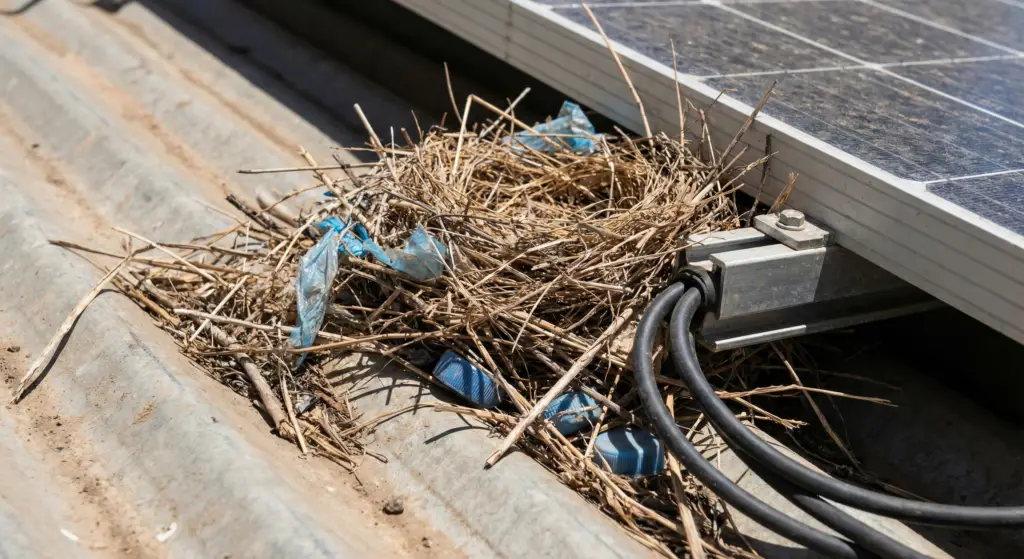
The intersection of high-voltage DC electricity and combustible nesting material constitutes a severe fire risk. This danger is not theoretical; it is a documented hazard that has drawn specific warnings from Australian emergency services and regulatory bodies.
Fire and Rescue NSW Data and Warnings
Fire and Rescue NSW (FRNSW) has been tracking a concerning trend in solar-related structural fires. Reports indicate a five-fold increase in solar panel fires over a five-year period. While a significant portion of these incidents are attributed to DC isolator faults, the presence of bird nests acts as a critical accelerant that transforms a minor electrical fault into a major structural fire.
The Ignition Mechanism
The area under a solar panel contains numerous electrical connections (MC4 connectors) and cables carrying high-voltage Direct Current (up to 600V-1000V in residential systems).
- Rodent Activity: Rats and mice often cohabit with pigeons in the sheltered solar void. These rodents have a biological need to gnaw to keep their incisors sharp, and PV cables offer an ideal target.
- Insulation Breach: If a rodent chews through the double-insulation of a DC cable, or if a bird pecks at the wiring, the live copper conductor becomes exposed.
- DC Arcing: Unlike Alternating Current (AC), DC does not have a zero-crossing point to help extinguish an arc. A DC arc is a stable, continuous plasma discharge that can reach temperatures exceeding 3,000°C.
- The Fuel Load: In a clean installation, an arc might melt a connector or singe the backsheet. However, when the area is packed with dry grass, twigs, feathers, and paper brought in by Indian Mynas, this fuel load ignites instantly. The draft created by the gap between the panel and the roof acts like a bellows, feeding oxygen to the fire and driving it rapidly into the roof cavity.
Regulatory Implications and Compliance
AS/NZS 5033: Installation and Safety of PV Arrays
Australian Standards require that PV arrays be installed in a manner that minimizes fire risk. The accumulation of debris explicitly contravenes the maintenance requirements of the system. System owners have a duty of care to maintain the safety of the installation. Failure to address a known infestation could potentially be viewed as negligence in the event of an insurance claim following a fire.
Warranty Voidance on Fire Damage
It is crucial to note that manufacturer warranties generally cover defects in materials and workmanship. They do not cover damage caused by “Acts of God” or environmental factors, which includes pest infestation. If a system catches fire because a pigeon nest ignited due to an arc fault, the manufacturer is likely to deny the warranty claim, citing improper maintenance. Furthermore, home and contents insurance policies often have exclusions for damage caused by vermin or pests, potentially leaving the homeowner liable for the entire repair cost.
Solar Mesh Exclusion (The Gold Standard)
In the hierarchy of bird controls, exclusion is the only method that addresses the root cause: access to the nesting site. Analysis of Australian market data and installer feedback confirms that a correctly installed mesh skirt is the definitive solution, offering 100% efficacy when specification and installation protocols are strictly followed.
Material Science: The Importance of Metallurgy
The harsh Australian climate, characterized by high UV index and coastal salt spray, demands rigorous material selection. The longevity of the proofing must match the 25-year warranty of the solar panels.
Stainless Steel (304 vs. 316 Grade)
The Premium Standard.
- Composition: Mesh made from 304 or 316-grade stainless steel is the industry benchmark. It is typically coated in a black, UV-stabilized PVC layer.
- Corrosion Resistance: Stainless steel is inherently resistant to rust. 316 “Marine Grade” is recommended for properties within 5km of the ocean due to its molybdenum content, which provides superior resistance to chloride pitting (salt spray).
- Rodent Resistance: Stainless steel wire with a diameter of roughly 1.0mm to 1.2mm is impervious to gnawing by rats and cockatoos.
- Aesthetics: The black PVC coating serves a dual purpose: it protects the metal and, crucially, absorbs light, making the mesh effectively invisible from the ground by creating a shadow line that blends with the panel frame.
Galvanized Steel
The Budget Compromise.
- Composition: Steel wire coated in a layer of zinc.
- Failure Mode: Over time, the zinc sacrifices itself to protect the steel. Once the zinc is depleted, the steel rusts. In coastal environments, galvanized mesh can fail within 3-5 years. Rust stains can then leach onto the roof, permanently damaging the aesthetic and structural integrity of Colorbond or tiles.
- Verdict: While cheaper upfront, it is a false economy for long-term assets like solar panels.
Polyethylene/Plastic Mesh
The “DIY” Trap.
- Composition: UV-stabilized plastic.
- Failure Mode: Despite “UV stabilization,” plastics eventually become brittle under the intense Australian sun. More critically, they offer zero resistance to rodents, who can chew through them in minutes to access the warm nesting site.
- Verdict: Not recommended for any professional application.
Technical Specifications for Efficacy
To guarantee exclusion, the mesh must meet specific geometric parameters:
- Aperture (Hole) Size: The optimal grid size is 12.5mm x 25mm (1/2″ x 1″).
- Why? A 12.5mm opening is too small for Mynas, Starlings, or Sparrows to pass through. However, it is large enough to allow airflow and prevent small leaf litter from building up and creating a dam that traps water.
- Wire Gauge: A minimum wire diameter of 0.9mm (before coating) is required to provide the structural rigidity necessary to span the gaps between clips without sagging or being bent by persistent birds pushing against it.
The “No-Drill” Installation Protocol: Preserving Warranties
A critical “pain point” for solar owners is the fear of voiding their panel warranty. Major manufacturers like LG, REC, and SunPower are explicit: drilling holes into the anodized aluminum module frame compromises the frame’s structural integrity and corrosion resistance, and voids the warranty.
The Fastening Solution
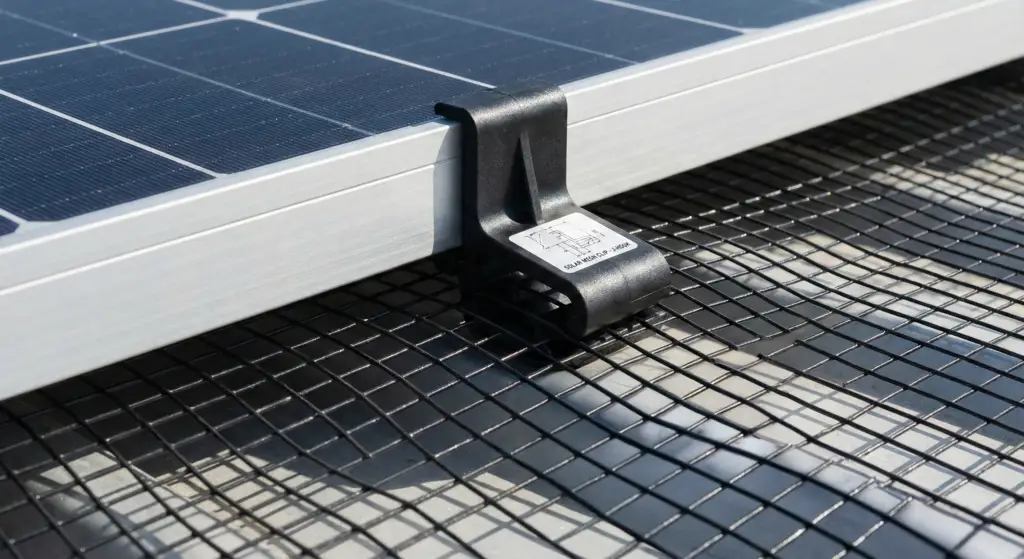
Professional bird proofing relies on specialized solar mesh clips (often called J-hooks or speed clips).
- Mechanism: These clips feature a hook that slides over the bottom lip of the panel frame and a self-locking washer that presses the mesh firmly against the side of the frame.
- Material: Clips should be made of UV-stabilized Nylon-66 or Stainless Steel.
- Galvanic Corrosion: If using stainless steel clips on aluminum frames, there is a theoretical risk of galvanic corrosion. However, the anodized layer of the frame usually acts as an insulator. Nylon clips eliminate this risk entirely but must be of high quality to withstand UV degradation.
The Installation Workflow
- Debridement: All nesting material must be physically removed from under the array. This often involves lifting panels or using specialized tools to hook debris out.
- Sanitization: The area must be treated with a biocide to kill mites, lice, and bacteria associated with the infestation. This is a critical health and safety step.
- Mesh Preparation: The mesh is rolled out and secured to the panel frames using clips spaced every 300mm to 500mm.
- Corner Fabrication: Corners must be slit and folded to create a seamless 90-degree wrap. This is a common failure point in amateur installations; birds will exploit any gap larger than 20mm.
- Roof Contouring: The bottom edge of the mesh must be trimmed to follow the profile of the roofing material. On corrugated metal (Colorbond), the mesh is cut to fit into the valleys. On tiles, it is trimmed to sit flush.
- Securing: The mesh acts as a spring, pushing against the roof to create a seal. It is not drilled or glued to the roof, allowing for water drainage and preventing damage to the roof membrane.
Mechanical Deterrents (Spikes and Wires)
Bird spikes are a ubiquitous pest control tool, but their application in the solar context is often misunderstood and misapplied. They function as a deterrent (making landing difficult) rather than an excluder (making entry impossible).
Functionality and Failure Modes
Spikes consist of rows of needle-like rods pointing upwards. They are highly effective on linear surfaces like building ledges, signage, and gutters where birds perch.
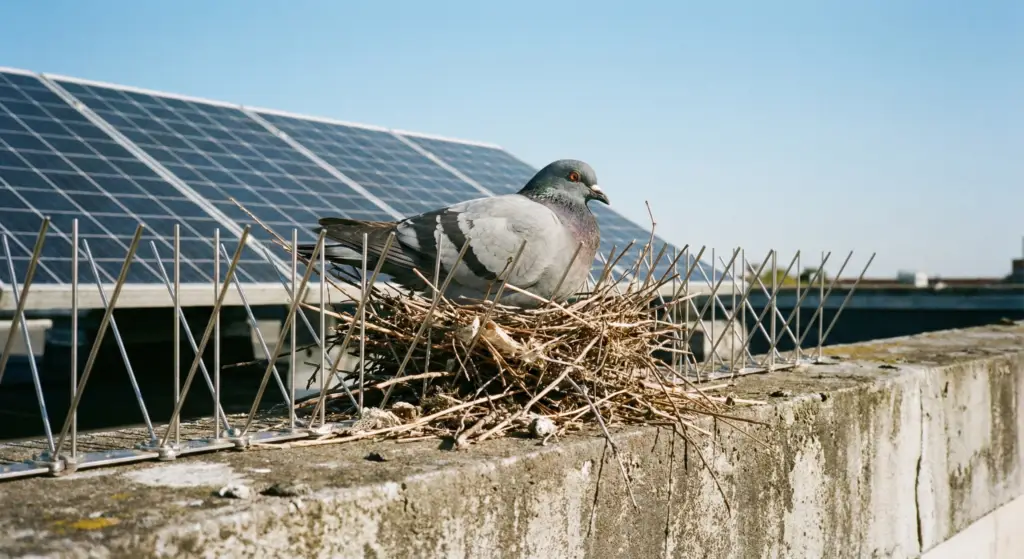
- The Solar Gap Failure: When installed on the edge of a solar panel, spikes do not block the gap underneath. A small bird (Myna or Sparrow) can easily land between the spikes or fly under the spiked area to access the void.
- Bridging Behavior: Pigeons are intelligent and persistent. Confronted with spikes blocking a desired nesting site, they have been observed dropping nesting material onto the spikes. The spikes then act as a structural anchor (rebar) for the nest, actually helping the bird build a more stable platform.
- Aesthetics: Spikes significantly alter the visual profile of the solar array, creating a “fortress” look that many homeowners find objectionable.
Appropriate Use Cases
While not a primary solution for the solar void, spikes have a role in a holistic defense strategy:
- Ridge Capping: Installing spikes on the roof ridge above the solar array prevents birds from perching and surveying the area, reducing the overall “bird pressure” on the roof.
- Gutters: Spiking gutters prevents perching and defecation into the drainage system, mitigating the risk of blockages.
Chemical and Sensory Repellents
Emerging technologies in the chemical and optical space offer discreet alternatives, primarily utilized where aesthetics are paramount or physical barriers are technically unfeasible.
Optical Gel Technology
Products such as Bird Free Optical Gel represent a multi-sensory approach to deterrence.
- Visual Mechanism: Birds can see into the Ultraviolet (UV) spectrum. The gel is formulated to absorb and re-emit UV light in a way that appears to the avian eye as a flickering flame. To the bird, the treated surface looks like it is on fire.
- Olfactory/Tactile Mechanism: The gels often contain natural oils (peppermint, citronella) that are offensive to birds, and the texture is sticky, discouraging physical contact.
Efficacy and Environmental Limitations
- The Dust Factor: Australia is a dusty continent. For optical gels to work, the surface must remain clean to interact with UV light. Over time, windblown dust coats the gel, diminishing its visual impact and covering the sticky surface.
- Lifespan: Manufacturers may claim efficacy of 3-5 years, but in harsh Australian conditions, re-application may be required every 12-24 months.
- The “Hop-Over” Effect: If gel is applied to the roof around the perimeter of the panels, determined birds may simply fly over the gel line and duck under the panel, bypassing the deterrent entirely. Unlike mesh, gel does not create a physical wall.
Use Cases
- Heritage Buildings: Where drilling or visible mesh is prohibited by heritage overlays.
- Complex Geometries: Areas with intricate pipework or racking where mesh installation is impossible.
Operational Safety and Installation Protocols
The installation of bird proofing is a high-risk construction activity. It involves working at heights, often on sloped surfaces, in close proximity to live high-voltage electricity.
Height Safety Hierarchy
In accordance with SafeWork NSW and SafeWork SA regulations, the risk of falls must be managed using the Hierarchy of Controls.
- Elimination: (Not possible for roof work).
- Passive Fall Prevention (Highest Order): The use of temporary edge protection (guard rails) or scaffolding is the preferred method. This creates a physical barrier preventing a fall.
- Work Positioning: Travel restraint systems that prevent the worker from reaching the edge.
- Fall Arrest (Lowest Order): A harness and lanyard system that catches the worker after they fall. This is the least preferred option due to the risk of suspension trauma and pendulum effect, yet it is the most common in the residential solar industry.
- Regulatory Warning: SafeWork NSW has a zero-tolerance policy for working on roofs without adequate fall protection. On-the-spot fines of up to $3,600 for individuals and $18,000 for businesses are applicable. Homeowners engaging “cheap” trades who flout these laws may find themselves liable if an accident occurs on their property.
Electrical Safety
- Live DC Danger: Solar panels are “always on” during the day. Even if the main switch is off, the DC cables on the roof are live with up to 600V.
- Isolation: Installers must follow a strict shutdown procedure (AC off, then DC Isolator off) before commencing work. However, the cables between the panels and the isolator remain live.
- Care Factor: Great care must be taken when removing nests not to pull or damage cables. If a cable is damaged, it must be replaced by a licensed electrician, not taped up.
Comparative Economic Analysis: ROI Modeling
The decision to install bird proofing is often an economic calculation. Is the upfront cost justified?
Cost Structures (2025 Australian Market Rates)
- Solar Mesh (Professional Install):
- Small System (3-5kW): $500 – $900
- Standard System (6.6kW – 10kW): $900 – $1,500
- Large/Complex System (15kW+): $1,500 – $2,500+
- Includes: Materials, labour, cleaning, waste disposal, warranty.
- Bird Spikes:
- DIY Materials: $10 – $30 per meter.
- Professional: $40 – $60 per meter.
- Note: Total cost often lower than mesh but effectiveness is significantly lower.
- Chemical Gels:
- Materials: $200 – $300 per kit.
- Note: Recurring cost every 2-3 years.
The Cost of Inaction (The “Do Nothing” Scenario)
- Efficiency Loss: A 6.6kW system in Sydney saves approximately $1,800 – $2,200 per year in electricity bills. A 20% efficiency loss due to soiling and heat buildup equates to a loss of $360 – $440 per year. Over 5 years, this loss ($1,800+) exceeds the cost of the bird proofing.
- Cleaning Costs: Professional panel cleaning costs $15-25 per panel. A yearly clean for a 20-panel system costs ~$400. Proofing eliminates or drastically reduces this frequency.
- Hardware Replacement: Replacing a single panel due to hotspot damage or a corrosion-failed microinverter can cost $300 – $500 (including call-out fee).
- Fire: The cost of a roof fire is catastrophic, involving insurance excesses, displacement, and loss of the solar asset.
Return on Investment (ROI) Verdict
For a standard residential system with a pigeon infestation, the payback period for professional mesh installation is typically 2.5 to 3.5 years based purely on efficiency recovery and avoided cleaning costs. When factoring in the extension of asset life and risk mitigation, the investment is mathematically sound.
Conclusion and Strategic Recommendations
The data is unequivocal: for the protection of rooftop solar assets against Australian pest birds, Solar Mesh Exclusion is the only technically sound, long-term solution.
Deterrents like spikes and gels attempt to modify bird behavior, a strategy that often fails against the powerful nesting instincts of Pigeons and Indian Mynas. Exclusion mesh, by contrast, modifies the environment, physically removing the habitat and forcing the birds to relocate.
Final Recommendations for Stakeholders
For Homeowners:
- Specify Quality: Request 304 or 316 Stainless Steel Mesh with PVC coating. Ensure the quote explicitly states “No-Drill Clips” will be used.
- Check Licenses: Ensure the installer holds a Working at Heights certification and, ideally, is a CEC (Clean Energy Council) accredited solar retailer or installer, ensuring they understand the electrical risks.
- Act Fast: Bird infestations obey the law of entropy; they only get worse. Proofing a clean system is cheaper than proofing a heavily infested one that requires hours of hazardous waste removal.
For Solar Installers:
- Upsell at Point of Sale: Offer bird proofing as an add-on during the initial solar installation. It is far cheaper to install mesh while the scaffolding is already up and the crew is on-site ($400-$600) than to return later ($1,000+).
- Protect Your Reputation: Installing a system that becomes a pigeon slum reflects poorly on the retailer. proactively managing this risk enhances brand value and customer satisfaction.
In the rapidly maturing Australian solar market of 2025, bird proofing has transitioned from an optional accessory to an essential component of system balance-of-plant (BOP). It is the insurance policy that ensures the 25-year promise of solar energy is actually delivered.
How much does solar bird proofing cost in Australia?
In 2025, professional solar mesh installation typically costs between u003cstrongu003e$500 and $900u003c/strongu003e for a small system (3-5kW) and u003cstrongu003e$900 to $1,500u003c/strongu003e for a standard 6.6kW system. This price includes UV-stabilized mesh, no-drill clips, panel cleaning, and waste removal.
Do bird spikes work on solar panels?
No, bird spikes are generally ineffective for solar panels. Pigeons and Indian Mynas often build nests u003cemu003eon topu003c/emu003e of the spikes, using them as a stable foundation. Spikes do not block access to the warm void underneath the panels, which is the primary attraction for nesting birds.
Will installing bird mesh void my solar panel warranty?
Not if installed correctly. Professional installers use specialized u003cstrongu003eu0022no-drillu0022 nylon or stainless steel clipsu003c/strongu003e that attach to the panel frame without drilling holes. This method preserves the structural integrity of the frame and keeps your manufacturer’s warranty intact.
References:
Fire and Rescue NSW: Solar Panel Fire Safety Warning & Statistics.
SafeWork NSW: Managing the Risk of Falls at Workplaces (Code of Practice).
Standards Australia: AS/NZS 5033:2014 – Installation and safety requirements for photovoltaic (PV) arrays.
Clean Energy Council: Solar PV Consumer Guide & Maintenance.
Disclaimer
This guide utilizes 2024-2025 market pricing and regulatory frameworks. It is intended for information purposes. Readers should verify current SafeWork guidelines and specific manufacturer warranty terms before commencing works.