
The Australian solar energy landscape has undergone a seismic shift over the last decade. With over 3.7 million rooftop solar photovoltaic (PV) systems installed across the continent, Australia leads the world in per capita solar uptake. As the installation boom stabilizes, the market has transitioned into a critical operational phase: asset maintenance. In 2025, the solar cleaning and maintenance industry is a burgeoning yet unregulated sector, often described by industry veterans as the “Wild West” of home services.
For the Australian consumer, this environment presents a complex matrix of pricing variables, service quality disparities, and hidden risks. A homeowner in Brisbane might encounter a $99 “whole roof” offer on social media, while a neighbor in the same suburb pays $350 for a similar service from a different provider. This price delta—often exceeding 300%—is not merely a reflection of competitive margins but a fundamental difference in service scope, insurance coverage, water quality, and safety protocols.
This report, Solar Panel Cleaning Cost Guide 2025: Are You Being Overcharged?, serves as an exhaustive, data-driven analysis of the current market. By synthesizing pricing data from major platforms like HiPages, ServiceSeeking, and direct contractor rate cards, alongside safety guidelines from SafeWork NSW and technical data on PV module care, we establish a transparent baseline for consumer expectations. We dissect the anatomy of a quote, revealing how factors such as roof pitch, height, biological growth (lichen), and avian pests influence the final solar panel cleaning cost Australia wide. Furthermore, we provide a critical risk assessment of the low-cost “cash-in-hand” economy, quantifying the hidden dangers of uninsured operators and the chemical threat of tap water on photovoltaic glass.
The Australian Solar Maintenance Landscape in 2025
From Installation to Preservation
The narrative of solar in Australia has shifted from “getting panels on the roof” to “keeping panels working.” As electricity prices remain volatile, the efficiency of existing systems is paramount. Research indicates that soiled panels can suffer efficiency losses ranging from 3% in standard suburban environments to over 25% in agricultural or high-pollution zones.1 This efficiency loss translates directly to inflated electricity bills, negating the financial benefit of the solar investment.
Consequently, the solar cleaning price list has become a critical document for household budgeting. However, unlike the installation sector, which is governed by the Clean Energy Council (CEC) accreditation scheme, the cleaning sector has no mandatory licensure. This lack of regulation allows a spectrum of providers to exist, from highly trained technicians using reverse-osmosis filtration systems to untrained laborers using abrasive brushes and garden hoses.
The “Wild West” of Pricing
Current market analysis for 2025 reveals a chaotic pricing environment. The disparity in quotes is driven by several macroeconomic and microeconomic factors:
- Insurance Premiums: Public Liability and Workers Compensation insurance costs for working at heights have risen significantly, forcing legitimate businesses to increase rates.3
- Equipment Costs: The cost of imported carbon-fibre water-fed poles and resin for de-ionization vessels has fluctuated with currency exchange rates, impacting operational overheads.5
- Labour Market: A shortage of skilled tradespeople willing to perform high-risk roof work has driven up hourly labour rates in capital cities.
- The Cash Economy: A surge in unregistered operators advertising on platforms like Facebook Marketplace and Gumtree creates artificial price deflation at the bottom end of the market, often at the expense of safety and quality.7
Consumers asking “Is $10 per panel too cheap?” or “Is $300 too expensive?” must understand that they are comparing fundamentally different service products. The following sections deconstruct these costs to empower Australian homeowners with the knowledge to discern value from risk.
The 2025 National Average: Market Rate Analysis
To determine if one is being overcharged, it is essential to establish a reliable benchmark. In 2025, professional solar cleaning pricing is generally structured in two ways: a per-panel rate or a flat fee based on system capacity.
The Per-Panel Pricing Model
The most granular metric for cost comparison is the price per panel. This model is favoured for larger residential and commercial systems where economies of scale apply.
- National Average Range: $10 – $20 per panel.9
- Budget/Volume Rate: $5 – $9 per panel. This rate is typically reserved for very large residential systems (40+ panels) or commercial arrays where setup time is amortized over a large number of units. It is also the price point for budget operators using lower-grade equipment.11
- Standard Professional Rate: $10 – $15 per panel. This is the standard rate for reputable companies cleaning accessible single-storey homes. It accounts for the use of DI water, insurance, and travel time.13
- Premium/Complex Rate: $15 – $25+ per panel. This bracket applies to double-storey homes, steep roofs (pitch >25°), or systems requiring specialized access equipment (harnesses, anchor points). It also reflects the higher cost of doing business in major metros like Sydney and Melbourne.15
Flat Fee System Cost Breakdown
For standard residential systems, most professional companies prefer a flat fee structure. This provides clarity for the consumer and covers the fixed costs of the service (vehicle expense, setup time, administrative overheads).
Small System (3kW – 5kW)
- Configuration: 10 – 16 Panels.
- 2025 Cost Estimate: $150 – $220.9
- Analysis: This system size is common on older installations or townhouses. The pricing here is heavily influenced by the “minimum call-out fee.” Most legitimate businesses have a minimum charge of $150 – $180 to make a site visit viable. Therefore, on a per-panel basis, a small system is the most expensive to clean (approx. $15 – $18 per panel). A quote of $99 for this system size is a red flag, as it barely covers the operational cost of a compliant business vehicle and insurance, suggesting corners are being cut elsewhere.8
Standard System (6.6kW)
- Configuration: 18 – 24 Panels.
- 2025 Cost Estimate: $200 – $280.17
- Analysis: The 6.6kW system is the “Toyota Corolla” of Australian solar—ubiquitous and standard. A quote between $200 and $250 is considered the market “sweet spot” for a single-storey property. This price should include a visual inspection of the panels and inverter. If a quote exceeds $350 for this system size on a standard roof without additional services (like lichen removal), the consumer is likely being overcharged. Conversely, a $120 quote suggests the use of tap water or uninsured labour.
Large Residential (10kW – 13kW)
- Configuration: 30 – 40+ Panels.
- 2025 Cost Estimate: $300 – $500+.9
- Analysis: As home electrification and EV charging drive demand for larger systems, 10kW+ arrays are becoming common. Cleaning these systems is labour-intensive, often taking 2–3 hours. The per-panel rate often drops to the $10 – $12 range due to volume, but the total invoice remains high. For systems of this size, professional companies may offer a “maintenance plan” discount for regular six-monthly cleans.
Regional Price Variations
Australia’s vast geography creates distinct micro-markets for solar services.
- Sydney & Melbourne: The high cost of living, toll roads, and insurance premiums push prices to the upper end of the spectrum. The average sits closer to $15 – $20 per panel, with flat fees for 6.6kW systems often starting at $250.1
- Brisbane & Gold Coast: A highly saturated solar market leads to fierce competition. Prices here can be slightly lower, with averages around $9 – $15 per panel. However, this region is also a hotspot for “fly-by-night” operators during storm season, requiring extra vigilance from consumers.8
- Perth: Rates are generally competitive, often cited from $5 – $10 per panel for accessible systems, though minimum call-out fees of $120+ prevent total costs from bottoming out.12
- Regional/Rural: While labour rates might be lower, travel surcharges are significant. Consumers in regional areas should expect to pay travel fees of $1.00 – $2.00 per km or a flat zone surcharge of $50 – $100.14
Data Table: 2025 Estimated Solar Cleaning Rates (AUD)
The following table synthesizes data from multiple sources including HiPages, ServiceSeeking, and direct provider rate cards to provide a consolidated view of 2025 pricing.
| System Size | Capacity (kW) | Panel Count | Single Storey Cost | Double Storey Cost | Price Per Panel (Avg) |
| Micro System | 1.5 – 3kW | 6 – 10 | $120 – $180 | $180 – $250 | $18 – $25 (due to min. fee) |
| Small Residential | 3 – 5kW | 10 – 16 | $150 – $220 | $220 – $300 | $12 – $18 |
| Standard Residential | 6.6kW | 18 – 24 | $200 – $280 | $280 – $380 | $10 – $15 |
| Large Residential | 8 – 10kW | 25 – 35 | $280 – $400 | $380 – $500 | $10 – $14 |
| Extra Large | 13kW+ | 40+ | $400 – $600+ | $500 – $750+ | $9 – $12 |
Table 1: Estimated market rates for professional solar panel cleaning in Australia, 2025. Sources:.9
The Hidden Factors: Why Quotes Vary
A common source of consumer frustration is receiving a final quote that exceeds the “advertised” price. This discrepancy is rarely arbitrary. It is the result of specific site conditions that increase the time, risk, or equipment required to complete the job safely. These are the “Hidden Factors” that legitimate professional solar cleaner near me searches will account for in their detailed quoting process.
The “Double-Storey Tax” (Height & Access)
Working at heights is the single most significant cost driver in the cleaning industry. Under the Work Health and Safety Act 2011 (and state equivalents like the OHS Act in Victoria), a fall from any height where injury could occur must be managed with strict control measures.23
- The Surcharge: Expect to pay $60 – $150 extra for a double-storey home, or see the per-panel rate rise to $15 – $25.13
- The Reason: Cleaning a double-storey home is not simply a matter of a longer ladder. It often requires:
- Industrial Fall Protection: Harnesses, ropes, and temporary anchor points if permanent ones are not installed.
- Water-Fed Poles: Utilizing heavy, high-modulus carbon fibre poles that can reach 30+ feet from the ground to avoid roof access where possible.
- Setup Time: The time taken to set up safety zones and secure ladders can often exceed the cleaning time itself.
- Risk Premium: Insurance premiums for working at heights are substantially higher. This cost is passed on to the consumer.
Roof Pitch: The Angle of Risk
The steepness of a roof determines whether a cleaner can walk on it or must be suspended from it.
- Standard Pitch (15° – 25°): Walkable with standard non-slip footwear. Standard rates apply.
- Steep Pitch (>25°): Non-walkable. This requires a “work positioning system” where the cleaner is fully supported by a harness in tension.
- Cost Impact: This slows the workflow significantly. A job that takes 1 hour on a flat roof may take 2.5 hours on a steep roof. Expect surcharges of 20% – 50% on the base rate.16
The “Terracotta Tax”: Roof Material Risks
Not all roofs are created equal. The material beneath the panels dictates the care required.
- Terracotta Tiles: These are notorious for being brittle, especially on older homes. A professional cleaner must navigate these roofs with extreme caution, stepping only on the reinforced sections (valleys) of the tile. This “tiptoeing” increases labour time. Furthermore, professionals carry the risk of breakage; a reputable company will have a policy to replace any tiles they break, a cost built into their service fee.26
- Decramastic / Slate: Some cleaners may refuse to walk on these delicate materials altogether, requiring the use of boom lifts or cherry pickers, which can add $300 – $500 per day to the cost for equipment rental.
- Metal (Colorbond): generally easier and faster to clean, but presents a slip hazard when wet.
The “Cheap Quote” Warning: Anatomy of a Solar Scam
In the high-inflation economy of 2025, the allure of a $99 cleaning offer is powerful. Social media platforms are inundated with ads promising “Whole Roof Solar Clean + Gutters for $99.” Consumers must understand that these offers often represent a significant financial and safety risk.
The Cash-in-Hand Economy Risk
Operators quoting rock-bottom prices often operate outside the formal economy. They are frequently uninsured, unregistered, and untrained.
- Public Liability Void: If an uninsured cleaner drops a tool on your car, breaks a window, or damages your neighbor’s property, you as the homeowner may be left with the bill. A professional carries $10M – $20M in Public Liability insurance, a policy that costs thousands annually.3
- Workers Compensation: If a “cash-in-hand” worker falls from your roof and suffers a catastrophic injury, the homeowner can be drawn into legal battles regarding liability for the unsafe workplace.
- Property Damage: A common horror story involves untrained cleaners cracking roof tiles and hiding the damage with silicone or simply ignoring it. Months later, during a storm, water ingress causes thousands of dollars in ceiling damage.26
The “Tap Water” Danger: Chemistry of Damage
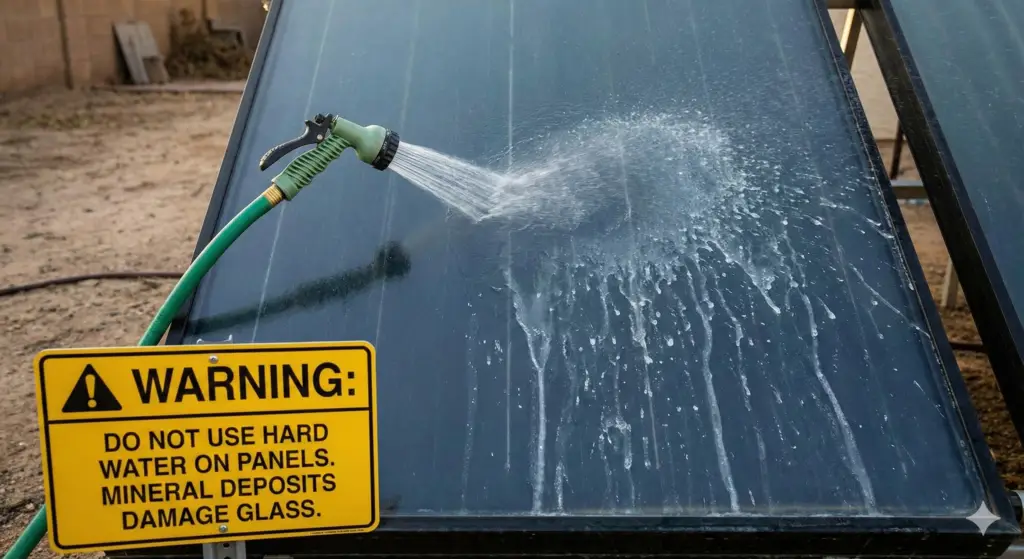
Perhaps the most insidious risk of the cheap cleaner is the water they use. Budget operators use standard garden hoses connected to your tap.
- Mineral Calcification: Australian tap water contains dissolved minerals like calcium, magnesium, and silica. When this water is left to dry on a hot solar panel, the water evaporates, but the minerals remain, baking onto the glass. This forms “hard water spots” or scale.
- Permanent Damage: Unlike dust, this scale bonds chemically to the glass and the anti-reflective coating. Over time, repeated washing with tap water creates a haze that permanently reduces the panel’s light absorption and efficiency.28 Removing this scale often requires harsh acids that can further damage the seals.
- Professional Standard: Professional cleaners use De-ionized (DI) or Reverse Osmosis (RO) water. This water has been filtered to 000 Total Dissolved Solids (TDS). It acts as a “hungry” solvent, absorbing dirt without leaving any residue, ensuring a spot-free finish that preserves the panel warranty.29
Pressure Washer Risks
The image of a cleaner blasting panels with a high-pressure Karcher is a definitive red flag.
- Micro-cracking & Seal Failure: Solar panels are designed to withstand rain, not 2000 PSI water jets. High pressure can force water past the rubber gaskets into the junction box, causing earth faults. It can also strip the anti-reflective coating and cause micro-cracks in the glass.31
- Warranty Void: Most manufacturers (e.g., LG, SunPower, Canadian Solar) explicitly state that the use of high-pressure cleaning equipment voids the warranty.29
Scam Checklist: When to Walk Away
- Price: Under $100 for a full system.
- Equipment: Garden hose or high-pressure washer visible.
- Insurance: Cannot produce a Certificate of Currency.
- Reviews: Profile has generic or hidden reviews on Facebook.
Specialized Services: Lichen and Bird Proofing
Beyond standard cleaning, environmental factors often necessitate specialized services. These are premium additions that legitimately increase the cost.
Lichen Removal: The Biological Battle
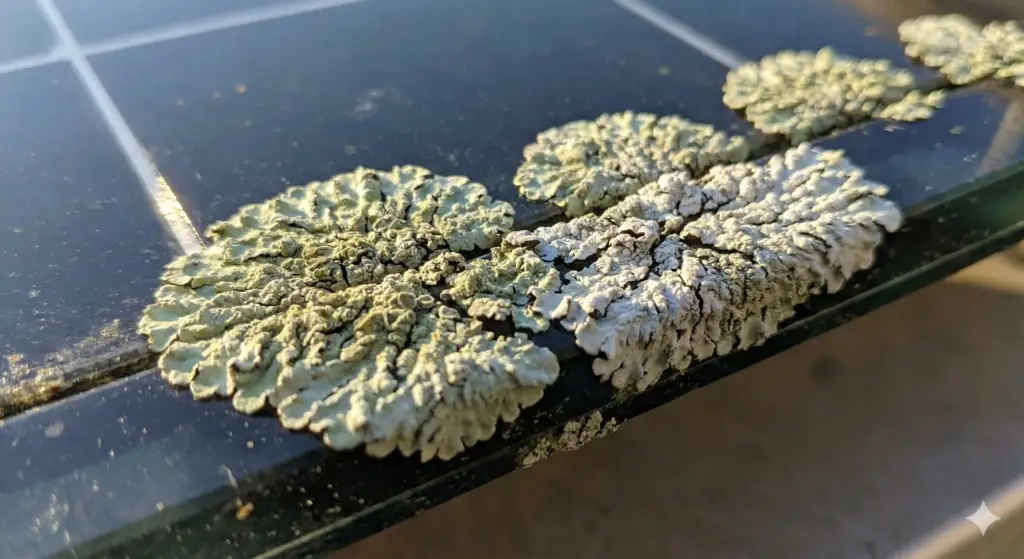
Lichen is a composite organism (fungus and algae) that anchors itself into the micropores of the solar glass and seals. It is common in humid areas or near trees.
- Why it Costs Extra: Lichen cannot simply be brushed off. Doing so would scratch the glass. It requires a chemical treatment (often a quaternary ammonium compound) to kill the organism, followed by a dwell time to soften it, and then gentle agitation to remove it. This process can double the time on site.
- Cost: Expect a surcharge of $6 – $10 per panel affected, or a flat fee of $100 – $200 on top of the clean.16
- The Risk of Ignoring: Lichen creates “hot spots” on panels. By permanently shading a specific cell, it forces that cell to work harder and heat up, eventually leading to diode failure or glass cracking.
Bird Proofing: Protection from Pests
Pigeons and other birds often nest under the warm shelter of rooftop solar arrays. This creates a fire hazard (dry nesting material near wiring) and a health hazard (accumulated droppings).
- The Solution: Installation of a UV-stabilized mesh skirt around the perimeter of the array.
- Cost: $500 – $2,000 per system.33
- Cost Drivers:
- Materials: High-quality stainless steel or UV-coated mesh and specialized “non-penetrative” clips (drilling into panel frames voids warranties) are expensive.
- Labour: This is a meticulous installation process involving cutting mesh to profile and fastening it securely. It is often a full day’s work for a team.
- Cleanup: The price usually includes the removal of existing nests and the pressure cleaning of the roof area (bio-hazard cleanup).35
DIY vs. Professional: A Cost-Benefit Analysis
For the pragmatic Australian homeowner, the DIY route is always a consideration. “Can I just buy the gear and do it myself?”
The Equipment Investment
To clean panels without damaging them (i.e., no tap water, no scratching), one requires professional-grade equipment.
- Water Fed Pole: A 20ft+ fibreglass or carbon fibre pole to reach panels from the ground.
- Cost: $150 – $400.36
- Filtration System: A DI vessel (e.g., Unger HydroPower) to produce pure water.
- Cost: $300 – $600 for a starter kit.6
- Resin Replacement: Consumable cost per year.
- Cost: $50 – $100.
- Safety Gear: Ladder, harness, rope.
- Cost: $200+.
Total Upfront DIY Cost: $700 – $1,300.
The Comparison Matrix
| Feature | DIY Approach | Professional Service |
| Upfront Cost | $700 – $1,300 (Equipment) | $0 |
| Recurring Cost | $50 – $100 (Resin/Soap) | $200 – $300 (Per Clean) |
| Time Investment | 2 – 4 Hours (Setup + Clean) | 0 Hours |
| Safety Risk | High (Falls, Injuries) | Zero (Insured Professional) |
| Water Quality | Variable (Depends on filter maintenance) | High (Guaranteed DI/RO) |
| Warranty Risk | Moderate (Accidental damage) | Low (Insured against damage) |
6.3 The Verdict
The payback period for DIY equipment is approximately 3 to 4 years (assuming one clean per year). However, this calculation ignores the safety risk. Falls from heights are a leading cause of traumatic injury in Australia. For a single-storey home where panels are reachable from the ground, DIY is a viable economic strategy. For double-storey homes, the risk of injury or death, alongside the potential for damaging roof tiles (repair cost: $300+), heavily favors hiring a professional. The $250 fee is effectively an insurance policy against personal injury and property damage.
Regional Market Breakdown
New South Wales (Sydney & Surrounds)
Sydney’s market is characterized by difficult access (terrace houses, steep coastal properties) and high insurance costs.
- Rates: Expect $15 – $25 per panel.
- Trend: High demand for bird proofing due to the urban pigeon population.34
Victoria (Melbourne)
Melbourne’s weather variability leads to heavy lichen growth, making chemical treatment a common add-on.
- Rates: $15 – $20 per panel.
- Note: Stricter WorkSafe Victoria enforcement on roof safety often necessitates higher access costs (scaffolding/rails).19
Queensland (Brisbane/Gold Coast)
A high-volume market with aggressive competition.
- Rates: $9 – $15 per panel.
- Warning: This region sees the highest number of “scam” operators post-storm season. Homeowners must verify ABN and insurance diligence.8
Western Australia (Perth)
A mature market with stable pricing.
- Rates: $5 – $10 per panel (plus call-out).
- Note: High prevalence of single-storey homes keeps average costs lower than the East Coast.12
Conclusion and Recommendations
The 2025 solar cleaning market in Australia is a case study in “you get what you pay for.” While the headline price of $10 per panel serves as a useful baseline, it is the context of that price—insurance, water quality, and safety—that determines value.
Recommendations for the Consumer:
- Reject the $99 Offer: It is statistically improbable for a business to operate legally and safely at this price point. The risks to your warranty and property are too high.
- Verify Insurance: Ask to see a Certificate of Currency for Public Liability (minimum $10M) before allowing anyone on your roof.
- Check the Water: Ensure the cleaner is using a DI or RO filtration system, not just a hose. Ask: “Do you use a de-ionizer?”
- Bundle Services: To reduce the effective cost, combine solar cleaning with gutter cleaning. Many professionals offer a 10–20% discount for bundled services.8
- Schedule for Winter/Spring: Book cleans in late winter or early spring to maximize efficiency during the peak solar generation months (summer).
By navigating the market with this data, Australian households can ensure their solar assets continue to deliver clean, cheap energy for decades, without falling victim to the hidden costs of the “Wild West” cleaning economy.
Market Data Sources
The following sources were utilized to compile the pricing and technical data for this report:
- Pricing Platforms: HiPages Price Guide 2023/2025 9, ServiceSeeking 39, AirTasker.40
- Service Provider Rate Cards: ACT Solar Cleaning 16, Gutter Suction Perth 12, Chimney Sweep Scotty 11, Shine Bright NSW 25, Bax Clean.22
- Safety & Regulation: SafeWork NSW “Managing the Risk of Falls” 23, Clean Energy Council.41
- Technical & Insurance: Eco Shine Solar (Water Chemistry) 29, Gleaming Insurance (Liability) 4, Energy Matters.17
- Consumer Protection: ACCC Scamwatch 7, SolarQuotes.42
How much does professional solar panel cleaning cost in Australia?
In 2025, the national average is between u003cstrongu003e$10 and $20 per panelu003c/strongu003e. For a standard single-storey 6.6kW system (approx. 20 panels), expect to pay a flat fee between u003cstrongu003e$200 and $280u003c/strongu003e. Double-storey homes incur extra safety charges ($50-$100).
Is the u0022$99 whole roof cleanu0022 a scam?
Often, yes. Legitimate businesses cannot cover insurance (Public Liability), travel, and equipment costs for $99. These operators typically use tap water (damaging panels) and lack insurance, leaving you liable for roof damage or injuries.
Does lichen removal cost extra?
Yes. Lichen grips into the glass pores and requires chemical treatment and dwell time. Expect to pay a surcharge of u003cstrongu003e$100 to $200u003c/strongu003e or an extra u003cstrongu003e$6-$10 per panelu003c/strongu003e for lichen removal services.
References
- Should You Hire a Professional Solar Panel Cleaner? Complete Guide – Econnex, fecha de acceso: diciembre 9, 2025, https://www.econnex.com.au/solar/blogs/should-you-hire-a-professional-solar-panel-cleaner
- Solar Panel Cleaning: Should You Hire a Professional Cleaner?, fecha de acceso: diciembre 9, 2025, https://www.solarchoice.net.au/solar-panels/cleaning/
- Renewable Energy Insurance – Crucial Insurance and Risk Advisors, fecha de acceso: diciembre 9, 2025, https://crucialinsurance.com.au/renewable-energy-insurance/
- Solar Panel Cleaning Insurance Specialists, fecha de acceso: diciembre 9, 2025, https://gleaminginsurance.co.uk/solar-panel-cleaning-insurance-specialists/
- unger – Window Cleaning Online, fecha de acceso: diciembre 9, 2025, https://windowcleaningonline.com.au/collections/vendors?q=unger
- UNGER HYDROPOWER ULTRA STARTER KIT – Kleenmart & Riverina Cleaning Supplies, fecha de acceso: diciembre 9, 2025, https://www.kleenmart.com.au/product/3295-unger-hydropower-ultra-starter-kit
- How to Avoid Common Solar Scams in Australia – Energy Matters, fecha de acceso: diciembre 9, 2025, https://www.energymatters.com.au/renewable-news/how-to-avoid-common-solar-scams-in-australia/
- About Us – All Coast Solar Panel Cleaning, fecha de acceso: diciembre 9, 2025, https://www.allcoastsolarpanelcleaning.com.au/?page_id=31
- How Much Does Solar Panel Cleaning Cost? [2025] – hipages, fecha de acceso: diciembre 9, 2025, https://hipages.com.au/article/how_much_does_solar_panel_cleaning_cost_2023
- How Much Does Solar Panel Cleaning Cost? (2025) – HomeGuide, fecha de acceso: diciembre 9, 2025, https://homeguide.com/costs/solar-panel-cleaning-cost
- Local Solar Panel Cleaning Service – From $8.80 Per Panel, fecha de acceso: diciembre 9, 2025, https://chimneysweepscotty.com.au/solar-panel-cleaning-service/
- Solar Panel Cleaning – Gutter Suction Perth – From $5 per panel …, fecha de acceso: diciembre 9, 2025, https://www.guttersuctionperth.com.au/solar-panel-cleaning/
- Best Local Solar Panel Cleaners Near Me (3 Free Quotes) – hipages, fecha de acceso: diciembre 9, 2025, https://hipages.com.au/find/solar_panel_cleaners
- Solar Panel Cleaning Service: Brisbane & Gold Cost, fecha de acceso: diciembre 9, 2025, https://pressurewashed.com.au/solar-panel-cleaning-service-brisbane-gold-cost/
- What is the cost of professional solar panel cleaning in 2025?, fecha de acceso: diciembre 9, 2025, https://cuttingedgewindowcleaningservices.com/what-is-the-cost-of-professional-solar-panel-cleaning-in-2025/
- Services Price List – ACT Solar Clean, fecha de acceso: diciembre 9, 2025, https://actsolarcleaning.com.au/services-price-list/
- How Much Does Solar Panel Cleaning Cost? Factors to Consider – Energy Matters, fecha de acceso: diciembre 9, 2025, https://www.energymatters.com.au/renewable-news/how-much-does-solar-panel-cleaning-cost-factors-to-consider/
- How Much Does Solar Panel Cleaning Cost? [2025] – hipages, fecha de acceso: diciembre 9, 2025, https://hipages.com.au/article/how_much_does_solar_panel_cleaning_cost
- Solar Panel Cleaning Melbourne | Solstra | Expert Electricians for Solar and Electrical, fecha de acceso: diciembre 9, 2025, https://www.solstra.com.au/solar/solar-panel-cleaning-melbourne/
- Solar panel cleaning cost Brisbane – The Girl Next Door, fecha de acceso: diciembre 9, 2025, https://yoursolarnetwork.com/solar-panel-cleaning-cost-brisbane/
- Cleanermate – Solar Panel Cleaning Perth | From $139, fecha de acceso: diciembre 9, 2025, https://mycleanermate.com.au/solar-panel-cleaning-perth/
- Solar Panel Cleaning Melbourne | Solar Cleaning Services – Bax Clean, fecha de acceso: diciembre 9, 2025, https://www.baxclean.com.au/solar-panel-cleaning
- Solar panel (rooftop) installation | SafeWork NSW, fecha de acceso: diciembre 9, 2025, https://www.safework.nsw.gov.au/hazards-a-z/solar-panel-retail-and-installation
- Working at heights | SafeWork NSW, fecha de acceso: diciembre 9, 2025, https://www.safework.nsw.gov.au/hazards-a-z/working-at-heights
- Solar Panel Cleaning – Central Coast – Shine Bright Property Maintenance, fecha de acceso: diciembre 9, 2025, https://shinebrightnsw.com.au/solar-panel-cleaning-central-coast/
- Considering Solar – what to watch out for? : r/australia – Reddit, fecha de acceso: diciembre 9, 2025, https://www.reddit.com/r/australia/comments/regxh3/considering_solar_what_to_watch_out_for/
- Solar Panel Cleaning Perth & Fremantle – All Glass Cleaning, fecha de acceso: diciembre 9, 2025, https://www.allglasscleaning.com.au/solar-panel-cleaning/
- Cleaning Solar Panels: Why, When and How You Should Do It – Energy Matters, fecha de acceso: diciembre 9, 2025, https://www.energymatters.com.au/renewable-news/solar-panels-cleaning/
- The Science Behind Pure Water Cleaning – Eco Shine Solar, fecha de acceso: diciembre 9, 2025, https://ecoshinesolar.com.au/solar-panel-cleaning/why-cleaning-with-pure-water-is-so-important-for-your-panels/
- What’s the most effective and safest way to clean solar panels? – Benz Softwash, fecha de acceso: diciembre 9, 2025, https://www.benzsoftwash.com/blogs/trade-tips/clean-solar-panels
- 5 things NOT to do when cleaning solar panels, fecha de acceso: diciembre 9, 2025, https://www.solaranalytics.com.au/solar-performance/5-things-not-to-do-when-cleaning-solar-panels-1
- Solar Panel Cleaning: What You Should And Shouldn’t Do!, fecha de acceso: diciembre 9, 2025, https://www.skylinesolar.com.au/solar-panel-cleaning/
- How Much Does it Cost to Pigeon Proofing Solar Panels? — Gutter …, fecha de acceso: diciembre 9, 2025, https://gutterguarddirect.com.au/blogs/solar-mesh/solar-mesh-cost
- How Much Does It Cost To Pigeon Proof Solar Panels?[2025] – hipages, fecha de acceso: diciembre 9, 2025, https://hipages.com.au/article/cost_to_pigeon_proof_solar_panels
- How Much Does It Cost to Pigeon-Proof Solar Panels in Australia Today? – The Gutter Cleaning Co., fecha de acceso: diciembre 9, 2025, https://theguttercleaningco.com/gutter-cleaning/pigeon-proof-solar-panels-cost
- Buy Water Fed Poles – Window Cleaning Supplies, fecha de acceso: diciembre 9, 2025, https://windowcleaningsupplies.com.au/water-fed/water-fed-poles.html
- Window Cleaning Packages – Cleaners Gallery, fecha de acceso: diciembre 9, 2025, https://cleanersgallery.com.au/collections/window-cleaning-packages
- Unger Hydropower Ultra Filter – Total Cleaning Supplies, fecha de acceso: diciembre 9, 2025, https://www.totalcleaning.com.au/UNDIUH2/Unger-Hydropower-Ultra-Filter/pd.php
- 10 Best Solar Panel Cleaning in Australia from $25/hr – Service Seeking, fecha de acceso: diciembre 9, 2025, https://www.serviceseeking.com.au/solar-panel-cleaning
- How Much Does Solar Panel Cleaning Cost in Australia (2025)? | Airtasker AU, fecha de acceso: diciembre 9, 2025, https://www.airtasker.com/au/costs/solar-panel-cleaning/solar-panel-cleaning-cost/
- Public liability insurance and landholder protection | Clean Energy Council, fecha de acceso: diciembre 9, 2025, https://cleanenergycouncil.org.au/for-consumers/fact-sheets/impacts-and-benefits-to-consumers-get-the-facts/public-liability-insurance-landholder-protection
- Is Solar Panel Cleaning A Waste Of Time And Money? – SolarQuotes, fecha de acceso: diciembre 9, 2025, https://www.solarquotes.com.au/blog/solar-panel-cleaning/